Change one word and the whole line is performed again, so the estimate counts that whole line, and only that line.
On our home page, every change you make to the sample script shows what it would cost before anything is generated. The figure beside a changed line is for the whole of that line, even when the change was a single word. This note explains why it is counted that way, and what the number is and is not.
A line is performed whole
A voice model does not paste a new word into an old recording. To change “east” to “west”, the line is performed again from its first word, so the new word sits in the same breath, pitch and pace as the words around it. A word stitched into a finished take tends to sound stitched.
Text-to-speech services bill the same way. ElevenLabs’ help centre puts it plainly:
When you press 'Generate' on the website, you will be deducted credits since the audio needs to be generated in order for you to hear it. This includes if you change the text and then regenerate, including in Studio.
ElevenLabs help centre, “Do I use quota on every generation?”, read 14 Nov 2026
So the honest unit for a change is the line. A line is what gets generated, so a line is what the estimate counts.
Only the line that changed
The other half of the rule matters more. When a script changes and nobody can say which lines moved, the safe thing to do is regenerate the whole scene, or the whole script, and pay for every line in it. Most of that money buys new takes of lines nobody wanted to change.
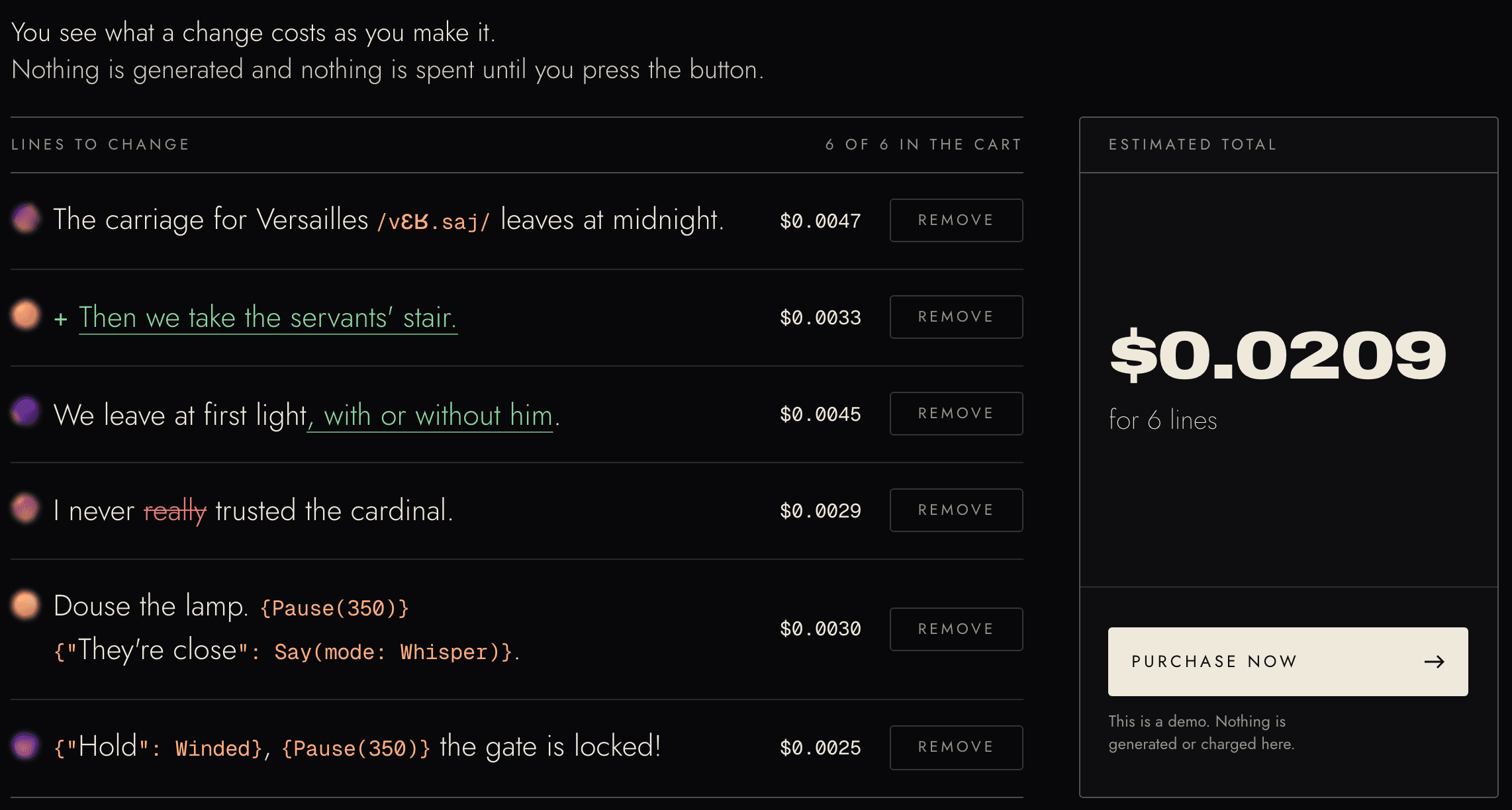
Tone is designed to keep each line under its own id, notice which lines’ words changed, and put only those lines in the cart. On our home page, cutting the word “really” from one of Odile’s lines puts that one line in the cart. The rest of her scene is left alone, and its takes stay as they were.
What is counted
The estimate counts the characters the voice will speak once the change is applied. Directions are not speech. A pause written as {Pause(350)}, or a delivery set on a word with {"Hold": Winded}, changes how the words are said and adds nothing to the count. A pronunciation note works the same way, so fixing how a name is said costs the line and not the note.
Here is the arithmetic for one real line, Avery’s from A Short Hike:
so there's this abandoned building to the west of here
54 characters × $0.10 per 1,000 characters = $0.0054
What the number is not
It is not a price. Tone has no published price yet, and nothing on this site is charged. The rate behind every estimate, $0.10 per 1,000 characters, is a proposed meter. It sits inside the range on the providers’ own pricing pages as we read them on 12 Nov 2026: from $0.015 to $0.08 per 1,000 characters for the models we compared, and $0.10 for Amazon Polly’s Long-Form voices (ElevenLabs, Inworld, Amazon Polly). The plans on our pricing page are proposed in the same way.
If the meter changes, every estimate changes with it. The rule underneath is the part we intend to keep: a change costs its line, and only its line.
Comments